When someone considers buying an electric car, the first question that comes to mind is how long it will take to charge the car they are buying. Many people believe that charging an electric car takes a long time, is very time-consuming, and isn’t as easy as filling up on petrol or diesel. This thought often deters people from buying an electric car.
But the truth is different. Charging time for an electric car depends on a few key factors, and if we understand those factors, the process isn’t as daunting as it seems. This article will discuss how long it takes to charge an EV, why it varies, and how to make it easier.
How long does it take to charge an electric car?
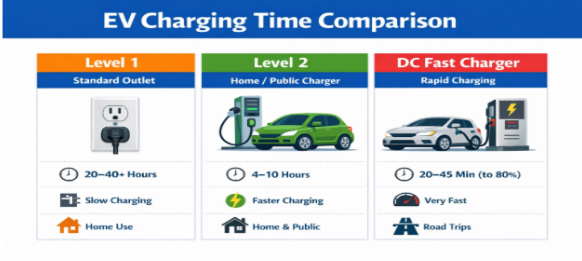
Charging an electric car can take anywhere from 30 minutes to over 40 hours.
- A DC fast charger can charge the battery up to 80% in about 20 to 45 minutes, and a full charge can take up to 1 hour.
- Using a Level 2 charger, which we often use at home, can take anywhere from 4 to 8 hours to fully charge the battery.
- Using a normal socket (Level 1) at home can take anywhere from 20 to 40 hours or even longer.
Now, let’s understand why there is such a difference in charging time.
What factors determine the charging of an EV?
Charging depends primarily on three factors: battery size, charger power, and the amount of charge already present in the battery.
- Battery capacity is measured in kilowatt-hours (kWh). Larger batteries have more energy, so they take longer to fully charge.
- Charger power is measured in kilowatts (kW). The more power, the faster the charging speed.
- Battery charging time also depends on how empty the battery is. For example, charging from 10% to 60% takes less time, whereas charging from 80% to 100% takes more time.
Charging from a normal household socket
Charging the car from a household socket is considered the easiest method because it does not require any special equipment.
However, while it is easy, it is also a very slow method. If the battery is empty, it may take more than a day to fully charge it.
The household method is suitable for those who don’t have to travel long distances and can leave their car at home for a long time, so they can leave it plugged in overnight.
Use a Level 2 charger at home
A Level 2 charger is much faster than a standard home socket. It is installed separately at home and is very convenient for daily use.
The result means that most cars take 4 to 10 hours to fully charge.
Most people charge their cars in the evening, and they are fully charged by morning. This eliminates the hassle of charging the car daily.
Use of a DC fast charger
A DC fast charger is the best option for quick charging. DC charging is the fastest way to charge an EV. It is mainly installed on highways or in large cities.
- It takes only 20 to 45 minutes to fully charge the battery.
- It is considered the best option for instant charging.
However, after 80%, the charging speed slows down slightly. Therefore, people charge up to 80% and then move on during long journeys.
Why does charging speed slow down after 80%?
When the battery is almost full, the charging speed slows down to avoid overloading the battery and keeping it from overheating, thus maintaining its life.
This is a safety measure, which is why it often takes longer to reach 100%.
Weather Effect
The weather also affects battery charging time. In winter, the average battery capacity decreases slightly, and charging becomes slightly slower.
The system regulates temperature to keep the battery safe even in the heat.
However, modern electric cars have a battery management system that attempts to mitigate these effects.
Is the charging process difficult for electric cars?
The charging process can be difficult and long when we first use it, but it becomes easier once we start applying it in our daily routine.
Most people charge at home at night, saving them a lot of time. And fast charging stations help during long journeys.
Conclusion
So, how long it takes to charge an electric car depends on the type of charger, battery size, and usage conditions.
Sometimes it can reach 80% charge in as little as 30 minutes, and sometimes it can take a whole day.
The best part is that the charging process can be easily incorporated into daily life, and with this knowledge and planning, driving an electric car becomes simple and quite convenient.