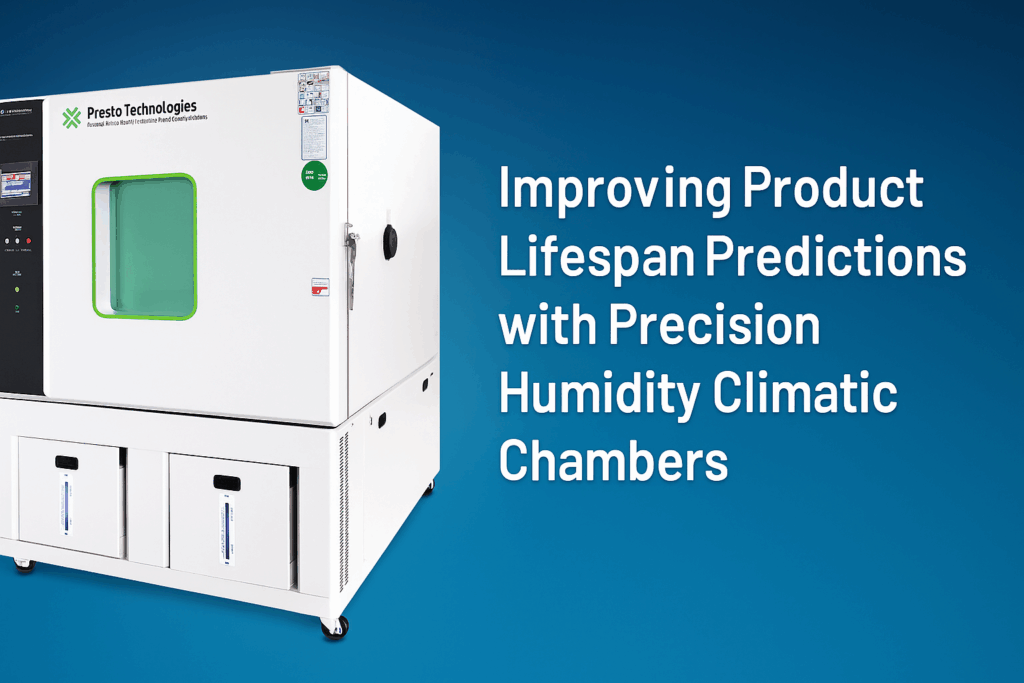
Today’s manufacturers recognize that having products that endure the rigors of use and failure is not simply a quality objective, but a competitive necessity. All manufactured products – including electronics, automotive parts, pharmaceuticals, and packaging materials – must perform under different conditions in a consumer’s environment before it reach the consumer. Environmental testing is essential to accomplish this, and the most important tool in this assessment is humidity climatic chamber testing. Utilizing climatic chambers allows manufacturers to achieve accelerated testing to replicate both ambient temperature and humidity fluctuations to help understand how well the materials and products perform over time.
Surely, climatic chambers provide a methodology for testing under stable, repeatable conditions, allow the manufacturer the ability to predict the service life of the product, identify weaknesses, and improve based on that data before it reaches a consumer.
Understanding the Role of Humidity Testing in Product Development
Humidity affects nearly every material—metals corrode, plastics deform, and electronic components malfunction when exposed to prolonged moisture or temperature changes. Testing products under controlled humidity and temperature conditions allows manufacturers to study material behavior under environmental stress.
This process not only ensures compliance with industry standards but also helps in improving product design, durability, and performance. By simulating accelerated aging, manufacturers gain insights into how their products might behave after years of real-world exposure, reducing costly recalls and improving customer satisfaction.
Precision Testing for Accurate Lifespan Predictions
The key advantage of using a humidity testing system lies in its precision. A well-calibrated testing setup ensures that both temperature and humidity are maintained consistently within a defined range. For instance, industries often test at varying humidity levels (30% to 95%) and temperatures (-10°C to 80°C or higher), depending on product specifications.
Such controlled simulations enable manufacturers to forecast product degradation accurately. This data helps R&D teams improve raw material selection, protective coatings, and assembly processes. The insights derived from these tests are invaluable for industries such as aerospace, defense, automotive, and electronics—where product failure can result in substantial financial or safety risks.
Design and Functionality of a Humidity Testing Chamber
A humidity chamber is designed with high precision to create consistent temperature and humidity cycles. It typically includes components like humidity sensors, digital controllers, air circulation systems, and thermal insulation to ensure uniform conditions throughout the chamber.
Advanced systems also feature programmable control interfaces, allowing engineers to create customized test cycles. For example, a manufacturer might expose a product to 40°C with 90% relative humidity for several hours, followed by a cooling phase to simulate rapid temperature fluctuations. These repeated cycles help evaluate how materials expand, contract, or degrade when subjected to long-term environmental stress.
Benefits of Using Humidity Climatic Chambers in Manufacturing
Incorporating humidity and temperature testing into the production process brings measurable benefits that go beyond quality assurance. Some of the most significant advantages include:
- Enhanced Reliability: Predicts real-world performance and prevents premature product failure.
- Regulatory Compliance: Ensures adherence to international testing standards like ASTM, ISO, and IEC.
- Reduced Costs: Identifies design flaws early in development, lowering rework and warranty claims.
- Faster Product Development: Provides quick, actionable feedback for material and process optimization.
- Improved Brand Reputation: Consistent product quality builds customer trust and long-term loyalty.
For manufacturers, these benefits translate directly into higher profitability and better market performance.
Why Precision Matters in Environmental Testing
A small deviation in humidity or temperature can lead to inaccurate data, making it impossible to predict product lifespan with confidence. Precision-controlled chambers ensure that test conditions remain stable over extended periods.
This accuracy becomes crucial for high-stakes sectors like medical devices or aerospace components, where performance reliability is non-negotiable. A precise humidity climatic testing setup not only replicates environmental conditions but also allows engineers to maintain traceability and documentation for audit and compliance purposes.
Presto Enviro: Setting the Standard in Humidity Testing Solutions
When it comes to reliability and innovation in environmental testing, Presto Enviro stands out as one of the leading manufacturers in the field. Their humidity chambers are engineered for precision, stability, and long-term performance—making them a trusted choice among top manufacturers and testing laboratories.
Presto Enviro designs its chambers with features like accurate digital controls, uniform air circulation, and durable stainless-steel construction to ensure dependable results. Each unit is tested for consistency, offering unmatched reliability across varied industrial applications. The company also provides excellent after-sales service and technical support, helping clients achieve uninterrupted testing and compliance assurance.
Moreover, Presto Enviro systems are built in accordance with global quality benchmarks, ensuring energy efficiency and cost-effectiveness without compromising test accuracy. These qualities make their humidity testing chambers an ideal investment for organizations seeking consistent and validated environmental testing results.
Conclusion
Predicting product lifespan with precision is crucial in today’s competitive manufacturing landscape. The use of advanced humidity climatic chamber systems enables organizations to simulate environmental effects accurately, ensuring better material performance and product longevity.