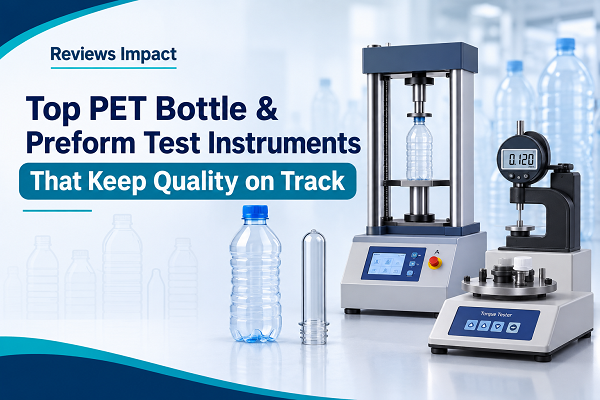
A PET bottle starts life as a small preform. Any flaw at that stage shows up later in the bottle. A weak wall, a tiny leak or a poor seal can ruin a full batch. Labs run regular checks to catch these problems early. This article covers five instruments that PET and preform teams use most. You will see what each one is, what it does and where it fits. At the end, there is a simple guide to picking the right one.
Top PET & Preform Test Instruments
A good lab does not need a long list of machines. It needs the right testing instruments to keep your product’s quality in check. These instruments measure the strength, shape, leaks, pressure and impact.
Top Load Tester
A top load tester is one of the most used PET bottle test instruments. It measures how much vertical weight a bottle can carry. The bottle sits on a flat base. A plate moves down at a set speed. The machine records the peak force when the bottle gives way.
This number matters more than most people think. Bottles get stacked high in warehouses and trucks. A weak one collapses and spoils the ones below it. Labs run this test to check wall thickness, bottle weight and design. It also helps teams cut resin use without losing strength.
Features:
- Digital display for clear readings
- Adjustable test speed
- Strong frame that stays steady under load
- Peak load value is easy to read
- Fits different bottle sizes with small changes
Applications:
- Checks crush strength of empty PET bottles
- Helps set a safe stacking height
- Compares bottle designs and weights
- Used for daily quality control on the line
- Works for jars and containers too
Preform Eccentricity Tester
A preform eccentricity tester is a key part of any set of preform test instruments. It checks how well centered a preform is. The preform is placed on a holder that rotates slowly. A gauge reads how much the surface shifts as it turns. A large shift means the neck and body are out of line.
Poor centering leads to uneven walls in the final bottle. One side ends up thin and the other thick. Thin spots fail first under load or pressure. The test is quick, so teams can pull samples straight from the injection molding machine. Mold problems get fixed early, before many bad preforms pile up.
Features:
- Revolving setup for smooth rotation
- Height adjustment knob for different sample sizes
- Holds the sample steady during the test
- Repeatable readings every time
- Simple to set up and use
Applications:
- Checks PET preform quality before blowing
- Spots uneven wall thickness early
- Helps find mold alignment problems
- Used on incoming preform lots
- Useful for bottle shape checks
Vacuum Leak Tester
A vacuum leak tester finds leaks in sealed PET bottles and containers. The bottle goes into a clear chamber filled with water. The operator then pulls a vacuum. If air escapes, bubbles rise from the exact spot of the leak.
Many leaks are too small to see or feel. They show up later as spills or spoiled products. This test catches them before bottles reach the filling line. It works on the cap seal, the neck finish and the bottle body. Results are easy to read, so even new staff can run it.
Features:
- Clear chamber to watch for bubbles
- Digital control for the vacuum level
- Adjustable vacuum and hold time
- Easy to clean after each use
- Handles bottles of different shapes
Applications:
- Checks the seal between bottle and cap
- Finds pinholes after blow molding
- Used for food and beverage packs
- Works for pharma and personal care bottles
- Helps sort out leaky batches fast
Bottle Burst Tester (Digital)
A bottle burst tester measures the internal pressure a PET bottle can take before it fails. The bottle is clamped in place and filled slowly with air or water. Pressure rises in a smooth, steady way. The display holds the highest value at the moment the bottle bursts.
This matters most for fizzy drinks. Carbonation pushes outward all the time, and heat makes it worse. A bottle that looks fine can still split in a hot truck. This PET testing instrument for bottles shows the real limit of a design. You can then set a safe margin for production.
Features:
- Digital pressure display
- Peak pressure is saved at failure
- Safe enclosure around the sample
- Smooth and controlled pressure rise
- Suits many bottle sizes
Applications:
- Checks carbonated drink bottles
- Tests new bottle designs
- Shows how wall thickness affects strength
- Used for batch approval
- Compares different resin grades
Impact Tester for Bottles
An impact tester for bottles checks how a PET bottle handles a sudden hit. A striker or weight is released from a fixed height onto the bottle. The force is the same every time. You then look for cracks, dents or breaks and note the result.
Bottles face knocks during filling, packing, shipping and daily use. A lab impact test is a safe way to see what could happen. It is also useful when you switch to a lighter bottle or a new resin. Teams use the results to compare options with fair data.
Features:
- Controlled and repeatable impact force
- Strong base that stays put
- Simple sample holding
- Clear view of the result
- Easy to use for routine checks
Applications:
- Checks bottles for shipping and handling stress
- Used in lighter bottle trials
- Compares resin batches
- Helps study drop damage
- Good for design and R&D work
How to Choose the Right Instrument for PET & Preform Quality Checks
To choose the right instrument, start with the problem you face most. Is the problem bottle collapse, leak or burst? Pick the tool that answers that first. Your lab does not buy everything at once. Add tools as your production grows. Here are a few things to look at when you shop for PET bottle test instruments.
- Test standards: Make sure the machine follows ASTM or ISO methods.
- Sample range: Check the bottle sizes and shapes it can hold.
- Accuracy: Ask for readings that repeat well.
- Display and data: A digital screen saves time and cuts mistakes.
- Build quality: A sturdy body lasts longer on a busy floor.
- Service and calibration: Ask who will fix it and how fast.
- Budget: Basic models cost less. Advanced ones cost more but give more data.
Conclusion
Good quality comes from a few simple checks. The top load test shows strength. The eccentricity test shows preform shape. The vacuum test finds leaks. Burst and impact tests show how a bottle handles stress. Together, these PET bottle test instruments and preform test instruments catch most problems before bottles leave the plant. Pick based on your product and your standards. Choose a maker that offers good service and calibration support. A small set of carefully selected instruments will serve your lab for years.